The first technology decision most founders get wrong
Startups · Apr 2026 · by Ascendra Labs
It isn't the stack. It's building the platform before the question, and paying compound interest on certainty you don't have.
It is never the stack. Founders agonise over frameworks and clouds, but the first real technology decision is quieter and much harder to undo: how much certainty to buy before the market has spoken.
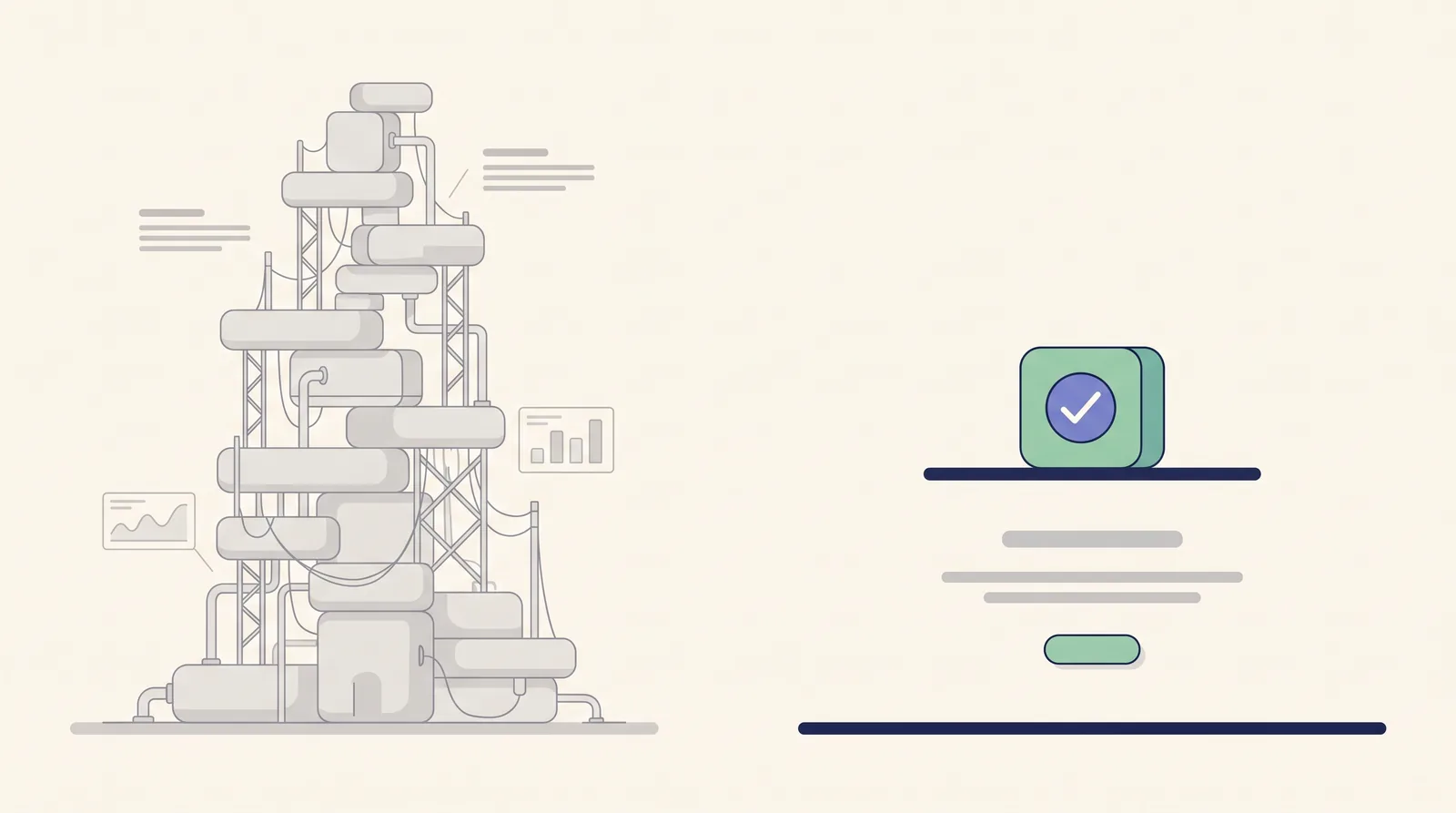
The platform-first instinct feels like discipline. Microservices, native apps, a pricing engine for prices nobody has paid yet. It looks like seriousness. It is actually a loan. Every layer you build before the question is answered is certainty bought on credit, and the interest comes due the day the answer comes back different from what you assumed.
We know how that sounds, so here is the evidence, because this is not a matter of taste. Start with why companies actually die. CB Insights read through hundreds of startup post-mortems and found that running out of cash tops the list, but they are careful to call that the final cause of death, not the root one. Underneath it, the largest real reason is the absence of a market: poor product-market fit shows up in well over forty percent of failures, and two-thirds of those were early companies that never found a market at all. They did not run out of money in the abstract. They ran out of money while finishing something nobody wanted.
Now the part that names the trap. The Startup Genome study of more than three thousand high-growth startups found that seventy-four percent of them failed from premature scaling, from building and spending ahead of the answer. Buried in the same report is the most useful sentence we have found for founders: startups need two to three times longer to validate their market than the founder expects, and that gap is what creates the pressure to scale too early. Read that again, because it is the whole problem in one line. The market takes longer to answer than you budgeted for, so you fill the anxious wait by adding certainty in the one place you fully control, the code, instead of the one place that decides your fate, the market.
The bill for that has a name, and even McKinsey, no enemy of the large build, has put numbers on it. In their work on technical debt, the CIOs they surveyed put that debt at twenty to forty percent of the entire value of their technology estate, and said ten to twenty percent of the budget meant for new products was going just to service it. That is compound interest in a sentence. The platform you over-built is not only sunk cost. It is a standing tax on your ability to change, paid out of the exact budget you will need on the day the market tells you it wanted something else.
The founders we admire buy certainty in the smallest denominations available. One flow. One payment rail. One month of real bookings. Their architecture is a consequence of evidence, not a prediction of it. This is not recklessness dressed up as wisdom, and the data rewards it specifically: Startup Genome found that founders who stayed light enough to pivot once or twice raised far more money and were far less likely to over-scale than those who committed too early or too hard.
None of this is new. It is just expensive to relearn. Marc Andreessen wrote almost twenty years ago that the only thing that matters is getting to product-market fit, and that when a great team meets a bad market, the market wins every time. A beautifully engineered platform is a great team's way of losing to a bad market slowly. Reid Hoffman said it from the other side: if you are not a little embarrassed by your first version, you launched too late.
We will grant the honest exceptions, because there are a few. In a validated market, where demand is known and the only real risk is delivering at scale, the platform genuinely is the differentiator, and certainty is cheap to buy because the answer is nearly in. In payments or health data, one rail built properly is not over-building, it is the smallest responsible denomination. Even McKinsey's own platform playbook, for all its enthusiasm, puts a minimum viable product and a customer test before the platform matures. The argument was never build versus do not build. It is dosage and timing.
So build the platform when the platform is the bottleneck. Until then, build the question. It is cheaper to answer, it is the only thing that can actually kill you, and unlike the platform, you cannot skip it.